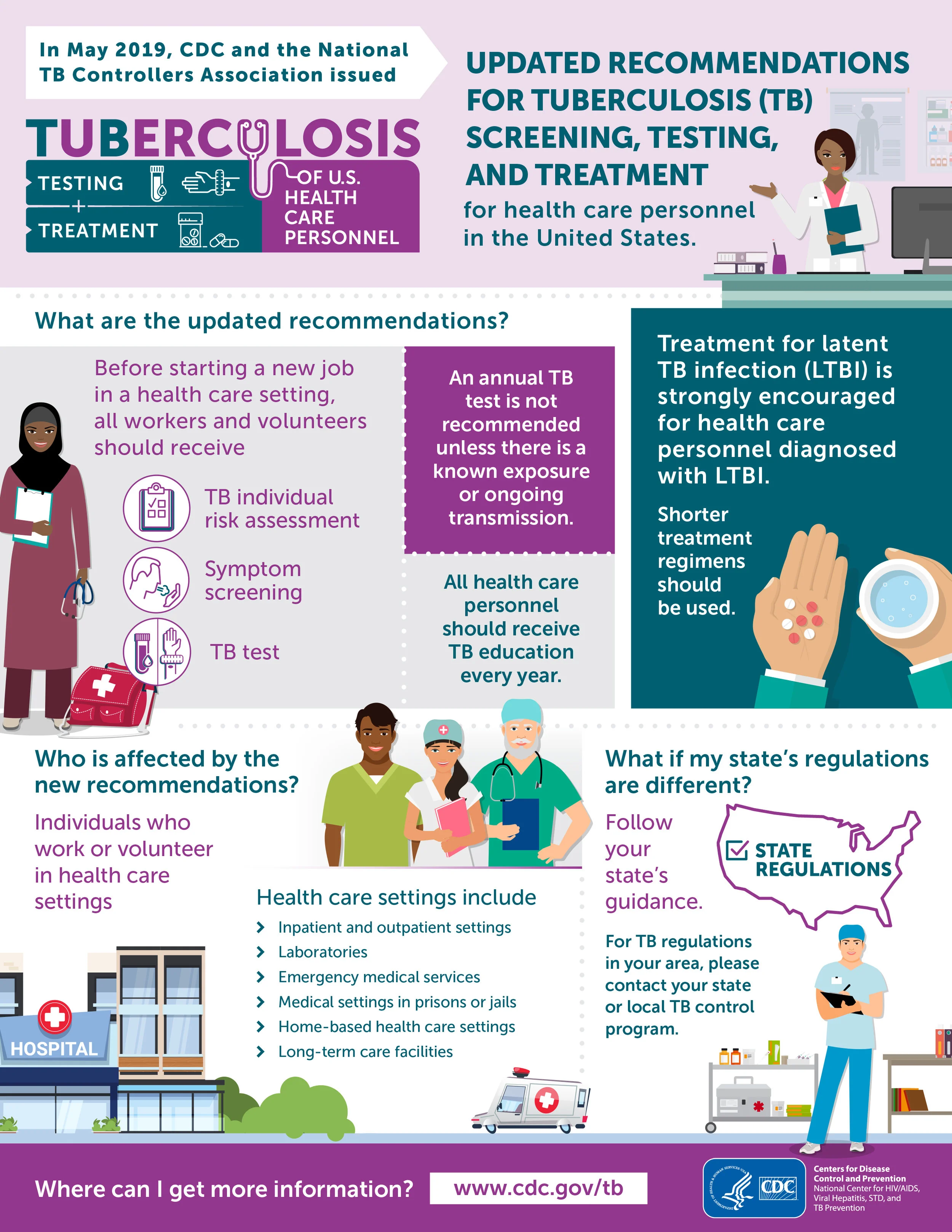
CDC Publishes TB Screening, Testing and Treatment Infographic

In May, the Centers for Disease Control and Prevention (CDC), in partnership with the National Tuberculosis Controllers Association (NTCA), released updated tuberculosis recommendations for screening, testing and treatment of healthcare personnel.

In support of these new TB guidelines, CDC has published a helpful infographic that summarizes the recommendations, shared below.

The infographic is available as a downloadable PDF, which can be accessed by clicking the image.

CDC Launches New Infection Control Training Course Series

Training.jpg

The Centers for Disease Control and Prevention (CDC) has launched a new infection control training course series.

The series will include 11 courses. The first two — available now — focus on hand hygiene and competency-based training. The courses are part of the new CDC/States Targeting Reduction in Infections via Engagement (STRIVE) curriculum, which was developed by infection prevention experts led by the Health Research & Educational Trust (HRET) for CDC.

The STRIVE curriculum will include more than 40 individual training modules. The CDC states that individual modules can be used for new employee training, annual infection prevention training and periodic training. They will be grouped into 11 courses that focus on foundational and targeted infection prevention strategies.

The courses are broken down as follows:

Foundational Infection Prevention Strategies

  • Hand hygiene

  • Competency-based training

  • Strategies for preventing healthcare-acquired infections (HAIs)

  • Environmental cleaning

  • Personal protective equipment (PPE)

  • Patient and family engagement

Targeted Infection Prevention Strategies

  • Catheter-associated urinary tract infection (CAUTI)

  • Methicillin-resistant Staphylococcus aureus (MRSA) bacteremia

  • Clostridioides difficile infection (CDI)

  • Central line-associated bloodstream infection (CLABSI)

All courses are free and offer continuing education.

Learn more about STRIVE and access the first two courses available here.

Study: S. Aureus Prevalent on Nursing Students' Cell Phones

The results of new research show the presence of Staphylococcus aureus (S. aureus) on the cell phones of many nursing students.

Researchers collected samples from 100 cell phones of students participating in nursing, biomedicine, pharmacy, dentistry and nutrition courses; 20 cell phones were collected from students in each course. The vast majority of bacteria detected was found on cell phones belonging to students in the nursing courses. Of the bacteria isolated, 85% were resistant to penicillin and half had the ability to adhere to surfaces. 

As noted in a news release about the research, which was conducted at the Western University of São Paulo, Brazil, "Nursing students are very likely to become carriers of S. aureus since clinical practice in hospital settings is part of their coursework and exposure to occupational hazards is inherent to this setting, which could favor the colonization and contamination of the surface of cell devices."  

While cell phones can be helpful tools, this research further shows that they can also contribute to infections when used in healthcare environments without proper disinfection.

Lizziane Kretli, professor at the Western University of São Paulo, said, in the release, "The widespread use of cell devices in hospitals and healthcare settings has raised major concerns about nosocomial infections, especially in areas requiring the highest standards of hygiene, such as the operating room."

The research was presented at ASM Microbe, the annual meeting of the American Society for Microbiology.